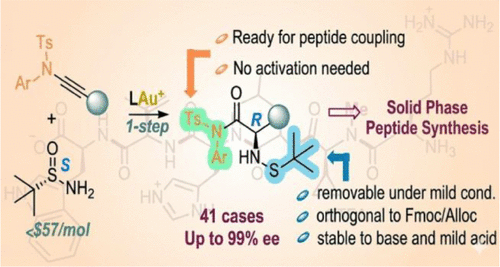
We are interested in both development of novel chemical transformations, especially those of transition-metal catalysis, directed SN2 glycosylation, and unnatural amino acid synthesis.
Au salts have been shown as exceptional catalysts to activate alkynes for nucleophilic reactions. However, Au-catalyzed activation of allenes has not been studied much. We are interested in general in Au-catalyzed reactions of allenes. Currently we are studying the reactivities of allenyl esters in the presence of Gold catalysts. Those allenyl esters can be generated in situ from readily available propargylic esters via the catalysis of the very same Au salts. A range of efficient Au-catalyzed tandem reactions of propargylic esters leading to novel structures and synthetically important intermediates have been developed.
Bifunctional Chiral Ligand Design
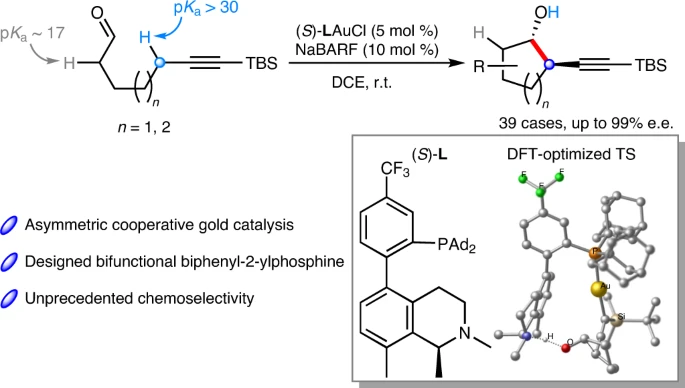
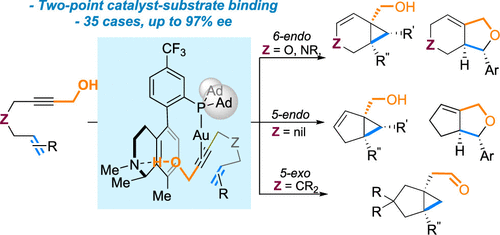
Asymmetric Au(I)-catalyzed reactions face unique structural challenges: after the substrate coordinates with the gold catalyst, the ligand’s coordinating atom-gold-substrate alignment forms a nearly linear arrangement with an angle of approximately 180°, which keeps the ligand far from the reactive substrate. we have developed various bifunctional biaryl-2-ylphosphine ligands possessing a remote Lewis/Brønsted basic group for the implementation of metal–ligand cooperation in gold catalysis.
Ting Li, Xinpeng Cheng, Pengcheng Qian, and Liming Zhang*. Gold-catalysed asymmetric net addition of unactivated propargylic C–H bonds to tethered aldehydes.
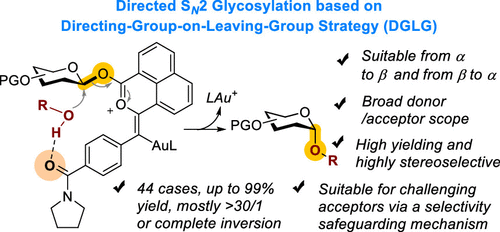
Chemical synthesis of these complex carbohydrate structures hinges on the stereoselective construction of glycosidic bonds. we developed a new and general approach to SN2 glycosylation by employing a directing group that realizes both conversions from α donors to β products and from β donors to α products, accommodates a broad range of sugar types, requires only two linear steps for the installation of a designed leaving group, and achieves exceptional stereoselectivity with challenging secondary acceptors.
Xu Ma†, Yongliang Zhang†, Xijun Zhu, Yongliang Wei, and Liming Zhang*. Directed SN2 Glycosylation Employing an Amide-Functionalized 1-Naphthoate Platform Featuring a Selectivity-Safeguarding Mechanism.
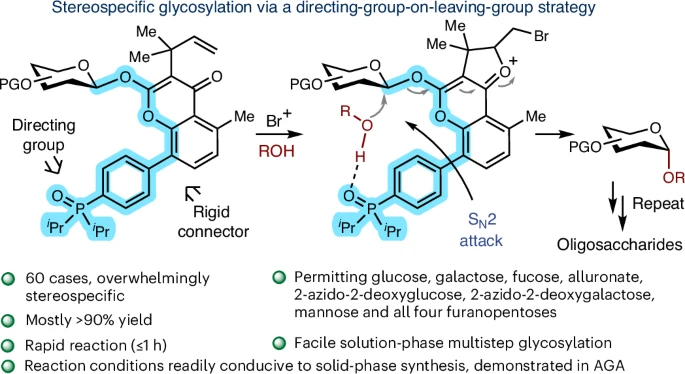
Qing Zhang, Nils J. Flodén ,Yongliang Zhang, Jielin Yang, Philip Kohnke, José Danglad-Flores, Eric T. Sletten, Peter H. Seeberger*& Liming Zhang*. A broadly applicable stereospecific glycosylation.
Unnatural amino acids play a pivotal role in protein engineering and drug discovery. However, their efficient and enantioselective synthesis remains a central challenge in organic chemistry. We develop a series of concise and practical approaches for the synthesis of diverse unnatural amino acid building blocks from readily available terminal alkynes.
Phillip Kohnke and Liming Zhang*. Expedient Synthesis of N-Protected/C-Activated Unnatural Amino Acids for Direct Peptide Synthesis.